
Sponge Spicule Structure
Explore the unique structure, chemical composition, and physical properties of sponge spicules through scientific analysis and microscopic characterization.
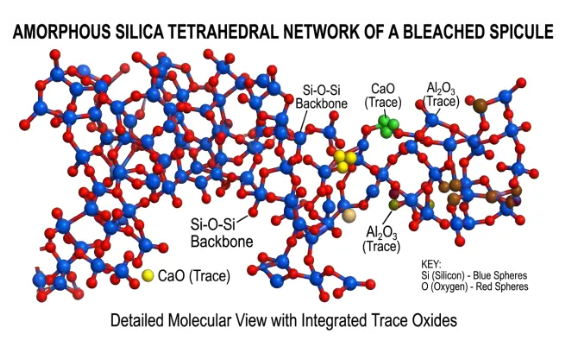
— EDS ELEMENTAL ANALYSIS
Elemental Composition
| Element | Proportion | Function |
|---|---|---|
| Oxygen | 51.8% (σ±0.4) | Structural stability — Si-O-Si covalent bonds form the silica skeleton |
| Silicon | 36.3% (σ±0.3) | Structural skeleton — Central element of the SiO₂ tetrahedral network |
| Carbon | 11.9% (σ±0.6) | Surface organic coating — Removed during the refining stage (23 steps) |
| Hydrogen | n.d.* | Water of hydration (· nH₂O), FTIR ν(O-H) + DTA confirmed |
*Note:The above information has been compiled based on publicly available resources.
Chemical Formula & INCI
SiO₂·nH₂O
Hydrated Amorphous Silica · Biogenic Amorphous Opal
HYDROLYZED SPONGE
International Cosmetic Ingredient Name (INCI):Hydrolyzed Sponge
IARC Group 3
Amorphous — Not Classified (Safety Group), CAS No. 7631-86-9
— SILICEOUS VS CALCAREOUS
Siliceous Spicules vs Calcareous Spicules
| Item | Calcareous Spicules (CaCO₃) | Siliceous Spicules |
|---|---|---|
| Chemical Composition | CaCO₃ Calcium Carbonate | SiO₂ · nH₂O Silicon Dioxide |
| Physical Hardness | Mohs Hardness 3 (Soft) | Mohs Hardness 6~7 (Hard) |
| Acid Reaction | Dissolves in acid | Stable (No reaction) |
| Biocompatibility | Moderate | Excellent (Inorganic Silica) |
| Microchannel Effect | Weak | Strong (Rigid Structure) |
| Skin Residue | Possible partial residue | Naturally excreted (Safe) |