
How Dose Sponge Spicule Work
Four core action mechanisms of sponge spicules: from microchannel opening to enhanced collagen synthesis.
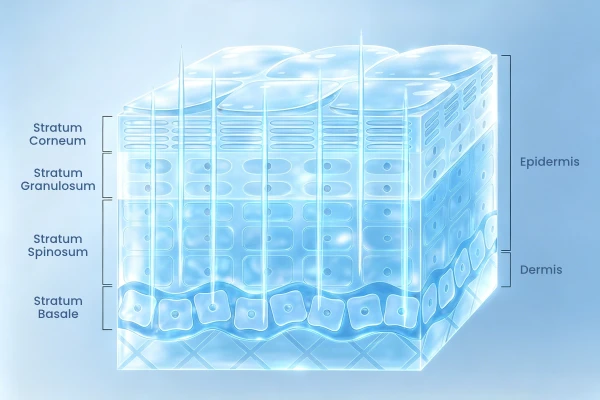
Skin Layers
Before diving into how spicule work affects skincare results, let’s briefly review the basic structure of the skin.
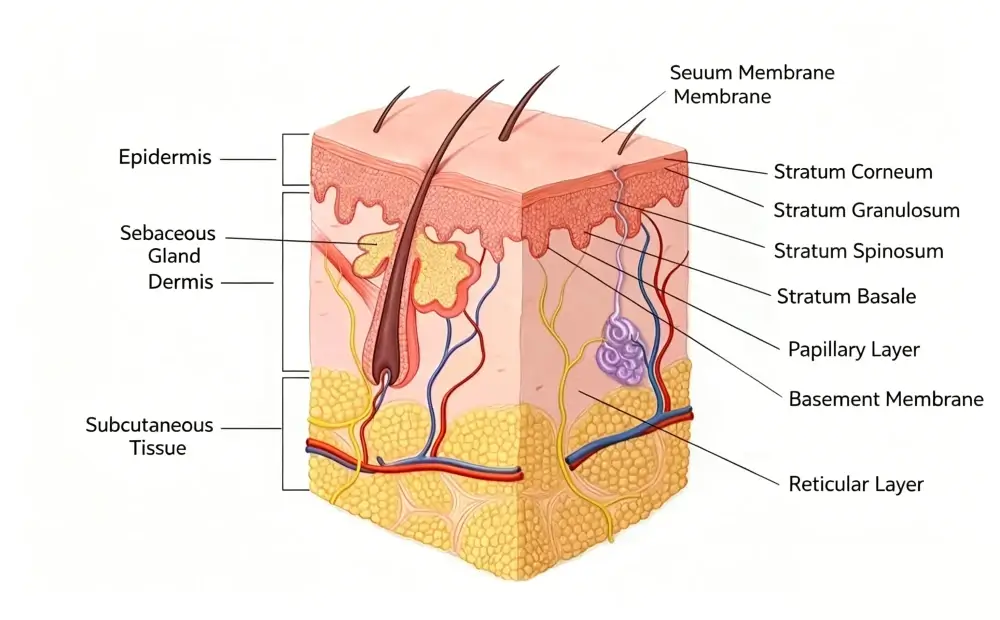
Epidermis – The visible outer layer, approximately 0.1–0.2 mm thick. It is further divided into five sublayers (from surface to base):
- Stratum corneum: The outermost layer of dead cells, providing barrier protection.
- Stratum granulosum: Where cells begin to keratinize.
- Stratum spinosum: The thickest layer of the epidermis, with spiny projections between cells that help transmit nutrients and signals.
- Stratum basale: The deepest layer of the epidermis, where new cells are generated and melanocytes reside.
- Dermis – Located beneath the epidermis, rich in collagen, elastin fibers, and capillaries. It provides skin elasticity and support.
Hydrolyzed sponge spicules primarily act on the epidermis. Depending on their length, they can reach the stratum granulosum, stratum spinosum, or stratum basale – without entering the dermis. This is key to their safe, non-invasive, yet effective action.
Spicule Length Ranges & Target Layers
Sponge spicules (also called hydrolyzed sponge or sponge spicule powder) typically range from 80 to 320 microns. Different lengths target different skin layers and produce varying levels of sensation and results.
The basic rule: shorter spicules are gentler, longer spicules penetrate deeper and deliver stronger effects. Based on practical application, we can divide spicule length into three main ranges:
1. 80–120 µm – Gentle
Target layer: Stratum corneum → Stratum granulosum
Sensation: Mild, almost painless
Key benefits:
Gentle removal of dead skin cells
Improves roughness and dullness
Enhances absorption of basic skincare ingredients
Best for: Daily cleansers, mild exfoliating lotions, sensitive-skin peeling masks
Skin types: Sensitive, dry, first-time users
2. 180–220 µm – Moderate
Target layer: Stratum spinosum
Sensation: Noticeable prickling/tingling, but tolerable
Key benefits:
Deeply unclogs pores, reduces blackheads and comedones
Promotes cell turnover, improves fine lines
Boosts penetration of active ingredients (e.g., niacinamide, peptides)
Best for: Oil-control serums, pore-clearing masks, moderate-strength exfoliation products
Skin types: Oily, combination, acne-prone
3. 270–320 µm – Intense
Target layer: Stratum basale (deepest epidermal layer)
Sensation: Strong, noticeable stinging – professional guidance recommended
Key benefits:
Potently stimulates collagen and elastin production
Significantly reduces acne scars, hyperpigmentation, and deep wrinkles
Enhances firmness and promotes deep skin regeneration
Best for: Professional-grade anti-aging serums, scar treatment patches, clinical treatment products
Skin types: Resilient skin, those with deep scarring or advanced aging concerns (use under professional supervision)
Summary Comparison Table
| Length Range | Target Layer | Sensation | Key Benefits | Best Product Types |
|---|---|---|---|---|
| 80–120 μm | Stratum granulosum | Gentle | Exfoliation, brightening | Daily cleansers, mild peels |
| 180–220 μm | Stratum spinosum | Moderate | Oil control, acne, penetration | Acne serums, moderate peels |
| 280–330 μm | Stratum basale | Intense | Anti-aging, scar repair | Professional anti-aging, clinical treatments |
Physical Channels + Penetration Enhancement
When sponge spicules are applied to the skin, gentle massage creates microchannels in the stratum corneum, significantly improving the transdermal absorption efficiency of active ingredients. Compared with conventional topical application, the penetration of active ingredients is greatly enhanced (Kim TG, 2022, PMID 35034416).
- What occurs when sponge spicule touches your skin?
- Spicules pierce stratum corneum to create fine physical microchannels
- Microchannels stay open up to 72 hours and close gradually
- Active ingredients (ampoules, serums) penetrate through microchannels
- Active ingredients reach the basal layer to nourish deep skin cells
16,000/cm²
The formation of physical microcanals
120h
Microchannel maintenance for 120 hours
73.4%
Absorption rate in the dermis 1
Promote cell self-repair and regeneration
Physical micro-stimulation generated by sponge spicules follows the same physical principle as microneedling (Percutaneous Collagen Induction, PCI) and fractional laser, triggering the skin’s natural wound-healing response.
Phase 1: Formation of Microchannels
Phase 2: Initiation of Skin Self-Repair
Phase 3: Increased Collagen Synthesis
Phase 4: Natural Shedding of Spicules
FAQ
What is sponge spicule (hydrolyzed sponge)?
Sponge spicules (INCI: Hydrolyzed Sponge) are the skeletal structures of sponges, primarily composed of silicon dioxide (SiO₂·nH₂O) in the form of microscopic needle-like structures. They are a siliceous extract obtained from freshwater sponges. With a diameter of tens of micrometers, these micro-needle structures form physical microchannels when applied to the skin, enhancing the penetration of active ingredient.
How long do spicules stay in your skin?
Spicules continue to work deep within the skin for up to 72 hours post-treatment
What are the side effects of spicules skincare?
- Transient irritation: Mild redness or prickling that usually subsides quickly.
- Barrier disruption: Overuse or high spicule concentration can compromise the skin barrier, leading to moisture loss or inflammation.
Not ideal for sensitive or compromised skin: Those with rosacea, acne-prone skin, or weakened barriers should exercise caution or seek professional advice.
How to use the hydrolyzed sponge?
It’s used for sure trouble skin such as acne, folliculitis, light wrinkles, only skin etc.
1) In salon and skin clinic, hydrolyzed sponge are used for peeling treatment, compared with other similar efficacy of application, hydrolyzed sponge only give skin pure rational stimulation, never hurt the dermis and never cause bleeding, never produce any side effects.
2) As a single and key ingredient to add into peeling cosmetics such as massage cream, provide functions of peeling. skin imitation and pores enlargement.
Can I mix different spicule lengths in one formula?
A: We do not recommend it. Mixing sizes can lead to uneven exfoliation and unpredictable skin response. Choose one target length based on your primary goal.
Does longer spicule always mean better results?
Not necessarily. Longer spicules provide deeper action but may cause more sensation. For daily-use products, 100–200 µm is often sufficient. For intensive treatments, 300 µm is preferred.
How do I know if my formula is too harsh?
Always conduct a patch test on human volunteers. Start with lower dosage and increase gradually. The sensation should be a mild “prickly” feeling, not sharp pain or burning.
Can I get a sample of each length for testing?
Yes. We provide 10g samples of 100µm, 200µm, and 300µm. Request samples now
References
- Kim TG, Lee Y, Kim MS, Lim J. (2022). A novel dermal delivery system using natural spicules for cosmetics and therapeutics. J Cosmet Dermatol, 21(10), 4754–4764. DOI: 10.1111/jocd.14771.
- El-Domyati M, Barakat M, Awad S, et al. (2015). Microneedling therapy for atrophic acne scars: an objective evaluation. J Clin Aesthet Dermatol, 8(7). PMID: 26203319.
- Aust MC, Reimers K, Repenning C, et al. (2011). Percutaneous collagen induction: scarless skin rejuvenation — fact or fiction?. J Plast Reconstr Aesthet Surg, 64(1). PMID: 20413357.
- Schmitt L, Marquardt Y, Amann P, et al. (2018). Comprehensive molecular characterization of microneedling therapy in a human three-dimensional skin model. PLoS One, 13(9). PMID: 30235356.
- Fernandes D. (2005). Minimally invasive percutaneous collagen induction. Oral Maxillofac Surg Clin North Am, 17(1). PMID: 18088764.
- Manstein D, Herron GS, Sink RK, et al. (2004). Fractional photothermolysis: a new concept for cutaneous remodeling using microscopic patterns of thermal injury. Lasers Surg Med, 34(5). PMID: 15216537.
- Drozdov AL, Zemnukhova LA, Panasenko AE, et al. (2021). Silicon Compounds in Sponges. Applied Sciences, 11(14), 6587. DOI: 10.3390/app11146587.
- Udompataikul M, Wongniraspai T. (2012). The study on effects and safety of Spongilla lacustris in 3% hydrogen peroxide solution on rat skin. J Med Assoc Thai, 95(Suppl 12), S15–S20. PMID: 23513460.
- Waghule T, et al. (2019). Microneedles: A smart approach and increasing potential for transdermal drug delivery system. Biomedicine & Pharmacotherapy, 109, 1249–1258.
- 1Prausnitz MR, Langer R. (2008). Transdermal drug delivery. Nature Biotechnology, 26(11), 1261–1268.
- Zhang C, Zhang K, Zhang J, et al. (2019). Skin delivery of hyaluronic acid by the combined use of sponge spicules and flexible liposomes. Biomaterials Science, 7(7), 2821–2831. PMID: 30821312.