Bio Microneedling Results: Why the First Week Matters
One of the most common questions we hear from skincare brands, salon owners, and treatment providers is surprisingly simple:
“When will clients actually start seeing results from bio microneedling?”
It’s a fair question.
The beauty industry is filled with dramatic before-and-after photos, but those images rarely explain what happens between the treatment and the final result. For someone considering bio microneedling for the first time—or for brands developing their own spicule-based treatments—understanding the recovery and renewal process is just as important as seeing the outcome.
In reality, bio microneedling isn’t about creating instant change. It’s about stimulating the skin’s natural ability to renew itself.
And that process follows a timeline.
Understanding How Bio Microneedling Works
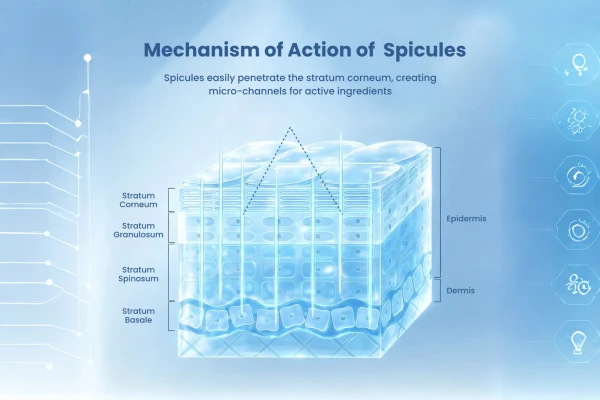
Unlike traditional microneedling, which uses metal needles to create controlled injuries in the skin, bio microneedling relies on microscopic sponge spicules.
These naturally derived silica structures are gently introduced into the epidermis during treatment. Once in contact with the skin, they create millions of microscopic stimulation points that activate cellular renewal processes.
The concept is simple: encourage the skin to behave as if it needs to repair itself, and it will naturally increase turnover, support collagen production, and improve overall skin quality.
What makes bio microneedling particularly interesting is that the stimulation continues after the treatment has ended.
The visible changes people notice over the following days are the result of biological processes that have already been set in motion.

The First 24 Hours: More Activity Than Results
Many first-time users expect to leave a treatment room looking instantly refreshed.
That usually isn’t the case.
Immediately after treatment, the skin is often slightly red and feels noticeably different. Some people describe the sensation as warmth, while others compare it to mild sun exposure. A prickly feeling is also common, especially when touching or cleansing the skin.
For experienced practitioners, these reactions are generally viewed as signs that the spicules have been successfully delivered into the skin.
At this stage, visible improvements are rarely the focus.
The skin is busy responding to stimulation, increasing microcirculation, and initiating repair mechanisms beneath the surface.
In other words, the work has started, even if the mirror doesn’t show dramatic changes yet.
Days Two and Three: The Stage That Causes the Most Questions
Interestingly, this is often the period when clients become impatient.
The initial redness may have settled, but the “glow” they’re expecting hasn’t fully appeared.
Some notice dryness.
Others experience a rough texture or mild flaking.
Occasionally, skin can even appear slightly duller than it did immediately after treatment.
This is completely normal.
From a biological perspective, the skin is transitioning into a renewal phase. Older surface cells begin making way for newer ones, while the stimulation created by the spicules continues encouraging cellular activity.
One misconception within the market is that visible peeling is necessary for good results.
In practice, we’ve observed that responses vary significantly between individuals. Some experience noticeable shedding, while others see very little visible peeling at all.
Neither outcome automatically indicates better or worse results.
Around Day Five: When People Start Noticing a Difference
By the middle or end of the first week, conversations tend to change.
Instead of asking whether the treatment is working, clients begin commenting on how their skin feels.
Words like “smoother,” “brighter,” and “cleaner” frequently come up.
Makeup often applies more evenly.
The complexion may appear more refined.
Pores can look less prominent.
Skin texture generally feels more uniform.
This stage is where many before-and-after photos are taken, and it’s easy to understand why.
The improvements are often visible without appearing artificial.
Rather than looking dramatically different, the skin simply looks healthier.
And for many consumers, that’s exactly the goal.
What Most Before-and-After Photos Don't Show
One thing we’ve learned through conversations with skincare professionals is that the most valuable benefits of bio microneedling are not always the easiest to photograph.
Photos capture surface improvements.
They don’t capture changes in skin behavior.
For example, clients frequently report that their skin feels less congested, appears more balanced, or responds better to their skincare routine in the weeks following treatment.
These observations are difficult to measure visually, but they are often among the reasons people return for additional sessions.
The treatment is not simply about creating temporary radiance.
It’s about encouraging healthier skin function over time.
Why Results Can Vary Between Treatments
Not all bio microneedling treatmentshow hydrolyzed sponge work produce identical outcomes.
Several factors influence the client experience, including treatment protocol, skin condition, aftercare compliance, and perhaps most importantly, spicule quality.
This is a topic that isn’t discussed often enough.
Many practitioners focus on concentration levels while overlooking differences in raw material quality.
However, the purity, consistency, and processing method of sponge spicules can significantly affect how predictable a treatment feels.
In our experience working with skincare manufacturers and professional treatment providers, higher-quality hydrolyzed sponge materials tend to deliver more consistent performance and a more controlled skin response.
That consistency becomes increasingly important as brands scale products and clinics expand treatment programs.
What Happens After the First Week?
The first seven days receive most of the attention because they’re when visible changes occur most rapidly.
But biologically, the process is far from complete.
Skin renewal continues beyond the first week.
Collagen synthesis and tissue remodeling take considerably longer than surface cell turnover. This means improvements in texture, elasticity, and overall skin quality may continue developing over the following weeks.
This is also why most professional treatment protocols recommend multiple sessions rather than a single treatment.
Each session builds upon the previous one, creating cumulative improvements that are often more significant than what can be achieved through a one-time procedure.
Is Bio Microneedling Worth It?
The answer largely depends on expectations.
If someone is looking for an overnight transformation, bio microneedling may feel underwhelming.
Healthy skin simply doesn’t work that way.
However, for individuals seeking gradual, natural-looking improvements in texture, radiance, and overall skin quality, bio microneedling offers a compelling alternative to more invasive approaches.
The most successful outcomes typically occur when people understand that the treatment is part of a process rather than a one-day event.
The before-and-after photos tell part of the story.
The real story is what happens during the days in between.
The Growing Demand for High-Quality Sponge Spicules
As bio microneedling continues gaining popularity worldwide, skincare brands are paying closer attention to the quality of the spicules used in their formulations and professional treatments.
At BestSpicule, we work closely with skincare brands, distributors, and aesthetic professionals who are developing next-generation bio microneedling solutions.
One of the conversations we have most often isn’t about marketing claims or before-and-after photos.
It’s about consistency.
Because in professional skincare, reliable results begin with reliable raw materials.
Understanding how sponge spicules are sourced, purified, and processed is often just as important as understanding what happens during the treatment itself.